


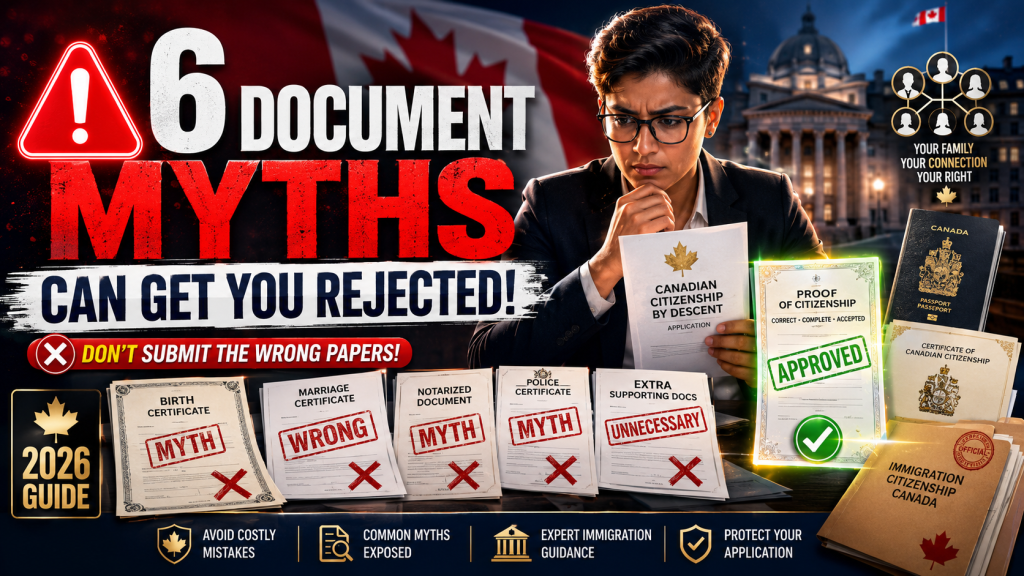
Canada’s expanded citizenship-by-descent rules have opened the door for millions of people with Canadian ancestry to claim Canadian citizenship. However, immigration experts warn that many applications are delayed—or even rejected—because applicants rely on common misconceptions about the documents Immigration, Refugees and Citizenship Canada (IRCC) will accept.
If you’re planning to apply for proof of Canadian citizenship, understanding these document myths can help you avoid costly mistakes and lengthy processing delays.
Myth #1: Only Your Canadian Ancestor’s Documents Matter
Many applicants believe they only need to prove that their parent, grandparent, or great-grandparent was Canadian.
Reality: IRCC requires evidence showing the complete family connection between you and your Canadian ancestor.
For example, if your grandfather was born in Canada, you’ll also need documents linking:
- You to your parent
- Your parent to your grandparent
- Your grandparent to the Canadian-born ancestor
Each generation must be supported with official records such as birth certificates or other accepted civil documents.
Myth #2: A DNA Test Can Prove Canadian Citizenship
Commercial DNA tests have become popular for genealogy research.
Reality: A DNA test alone cannot prove Canadian citizenship.
IRCC does not accept self-arranged DNA test results as proof of citizenship or family relationship.
In rare cases, IRCC may request DNA testing during processing, but only through an approved laboratory following official instructions.
Myth #3: An Online Family Tree Is Acceptable Evidence
Many applicants submit family trees created through websites such as genealogy platforms.
Reality: Family trees can help you research your ancestry, but they are not official evidence.
IRCC requires documents issued by the original authority, including:
- Civil registration offices
- Vital statistics agencies
- Provincial archives
- Government record offices
Third-party genealogy websites cannot replace official records.
Myth #4: Copies From Secondary Sources Are Good Enough
Some applicants submit newspaper clippings, historical books, unofficial transcripts, or copied records from private organizations.
Reality: IRCC increasingly requires documents issued directly by the authority that originally created or maintains the record.
Secondary-source documents may be useful for research but usually do not satisfy official proof requirements. Recent policy changes have increased scrutiny of these types of documents.
Myth #5: Missing Documents Automatically Mean You Cannot Apply
Many people assume that if an old birth certificate or marriage record is unavailable, they have no chance of qualifying.
Reality: Missing records do not necessarily end your application.
If an official document cannot be obtained, applicants may be able to provide:
- Proof that the record no longer exists
- Archive search results
- Alternative government-issued records
- Additional supporting documentation accepted by IRCC
Every case is different, and applicants should follow IRCC’s guidance for unavailable records.
Myth #6: If You’re Eligible, Documents Don’t Matter Much
Some applicants believe that because the law now allows citizenship through multiple generations, documentation is less important.
Reality: Eligibility alone is not enough.
You must still prove your entitlement with complete, verifiable evidence.
Recent reports show that IRCC has:
- Increased document verification
- Requested additional evidence from some applicants
- Paused or reviewed certain citizenship-by-descent files where documentation did not meet current standards
Accurate documentation is now more important than ever.
📋 Documents Commonly Required
Depending on your situation, IRCC may require:
- Birth certificates
- Marriage certificates
- Death certificates
- Canadian citizenship certificates
- Canadian birth records
- Naturalization records
- Certified translations (if documents are not in English or French)
Ensure all documents are official, legible, and issued by the appropriate government authority.
💡 Tips to Strengthen Your Application
To reduce the risk of delays:
- Collect official records for every generation in your family line.
- Avoid relying solely on genealogy websites or DNA tests.
- Submit certified translations when required.
- Check that all names and dates match across documents.
- Keep copies of everything you submit.
📌 Final Thoughts
Canada’s citizenship-by-descent reforms have created new opportunities for people with Canadian ancestry around the world. However, proving your eligibility requires much more than identifying a Canadian ancestor. A successful application depends on providing a complete chain of official documents that clearly establishes your family relationship and citizenship entitlement.
Before applying, review your documents carefully and ensure they meet IRCC’s current requirements. Doing so can help you avoid unnecessary delays and improve your chances of receiving your Canadian citizenship certificate.


