


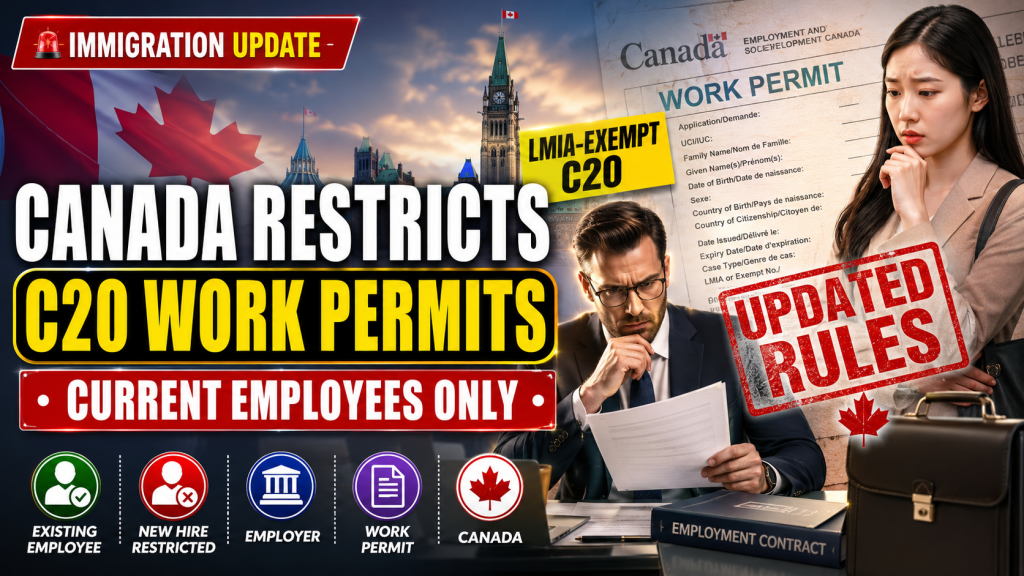
Canada has introduced an important policy change affecting LMIA-exempt work permits issued under the Reciprocal Employment (C20) category of the International Mobility Program (IMP). Effective July 29, 2026, Immigration, Refugees and Citizenship Canada (IRCC) now requires that foreign nationals must already be employed by the overseas company before they can qualify for a C20 reciprocal employment work permit.
This update narrows eligibility for one of Canada’s most commonly used LMIA exemptions and is expected to affect multinational companies, educational institutions, international organizations, and foreign workers planning transfers to Canada.
📌 What Has Changed?
Previously, employers could use the C20 Reciprocal Employment exemption to hire foreign workers whose employment with the overseas organization would begin upon arrival in Canada.
Under the updated policy, this is no longer permitted.
To qualify for a C20 work permit, the applicant must now:
- ✅ Be currently employed by the company outside Canada.
- ✅ Be transferring or assigned to work in Canada under a reciprocal employment arrangement.
- ✅ Meet all other eligibility requirements under the International Mobility Program.
Applicants who are only expected to start working for the foreign employer after arriving in Canada will not qualify under this exemption.
📊 Old Rule vs. New Rule
| Previous Policy | New Policy (From July 29, 2026) |
|---|---|
| Future employees could qualify in some cases | Only current employees qualify |
| Focus on overall reciprocal labour market benefits | Focus on active employment and genuine knowledge exchange |
| Greater flexibility for new hires | Stricter eligibility requirements |
The revised guidance emphasizes that reciprocal employment should facilitate the exchange of skills, knowledge, and experience between existing employees rather than serve as a pathway for recruiting individuals who have not yet joined the organization.
💼 What Is the C20 Reciprocal Employment Work Permit?
The C20 LMIA exemption allows certain foreign nationals to work in Canada without requiring a Labour Market Impact Assessment (LMIA).
The exemption applies where Canadian workers receive comparable employment opportunities abroad through reciprocal arrangements.
Typical employers using this pathway include:
- 🌍 Multinational corporations
- 🎓 Universities and academic institutions
- 🏛️ Government organizations
- 🤝 International non-profit organizations
The objective is to create balanced international employment opportunities that benefit both Canada and partner organizations overseas.
🌎 Reciprocity Doesn’t Need to Be Country-to-Country
IRCC also clarified that reciprocal employment does not have to exist directly between two countries.
For example:
- A multinational company may transfer employees between offices in different countries.
- Canadian employees working in international offices can satisfy the reciprocity requirement even if they are not exchanged with workers from the same country.
This clarification recognizes the global structure of many multinational employers.
❌ Who Is Affected?
The policy change mainly affects:
- Foreign nationals who have received a future job offer but have not yet started working for the overseas employer.
- Employers planning to recruit new international staff directly into Canadian positions using the C20 exemption.
- Organizations relying on reciprocal employment arrangements for international recruitment.
Existing employees already working for the overseas company remain eligible if they meet the other program requirements.
📌 What If You No Longer Qualify?
If a foreign national does not meet the updated C20 requirements, employers may need to consider other immigration options.
Possible alternatives include:
- Applying through another International Mobility Program (IMP) exemption, if eligible.
- Applying under the Temporary Foreign Worker Program (TFWP), which generally requires obtaining a Labour Market Impact Assessment (LMIA).
- Exploring work permits available through free trade agreements or other employer-specific LMIA exemptions.
Obtaining an LMIA typically involves additional recruitment requirements, processing time, and employer costs.
📋 Why Did Canada Make This Change?
According to IRCC, the revised guidance ensures that reciprocal employment genuinely supports:
- Knowledge transfer.
- Professional experience sharing.
- International workforce mobility.
- Balanced employment opportunities for Canadians abroad.
The department noted that individuals who only begin working for the foreign employer upon arriving in Canada do not provide the same reciprocal exchange intended under the C20 exemption.
🎯 What This Means for Employers
✔ Review International Transfer Plans
Employers should confirm that employees have an established employment relationship with the overseas organization before submitting a C20 work permit application.
✔ Update Recruitment Strategies
Organizations that previously hired new international recruits directly under the reciprocal employment exemption may need to consider different immigration pathways.
✔ Plan Earlier
Companies should begin overseas employment before arranging Canadian transfers where the C20 exemption is intended.
✔ Consider Alternative Work Permit Options
Where C20 eligibility is not available, employers should assess whether another LMIA exemption or an LMIA-supported work permit is more appropriate.
📌 Final Thoughts
Canada’s latest update to the C20 Reciprocal Employment work permit category represents a significant tightening of LMIA-exempt work permit rules. By limiting eligibility to current employees of overseas organizations, IRCC aims to preserve the original purpose of reciprocal employment—facilitating genuine international exchanges of knowledge and professional experience rather than serving as a recruitment pathway for new hires.
Employers and foreign workers should carefully review the updated eligibility criteria before submitting a work permit application. Those who no longer qualify under the revised C20 rules may need to explore alternative immigration options, including other LMIA exemptions or the Temporary Foreign Worker Program.


