


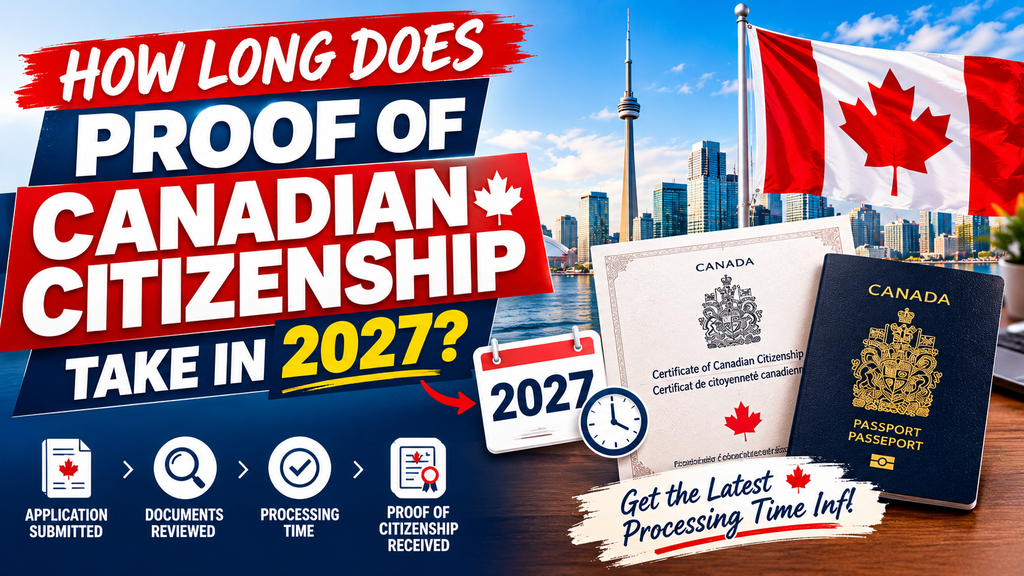
Applying for proof of Canadian citizenship can take several months or even years, depending on how quickly you gather the required documents and how long Immigration, Refugees and Citizenship Canada (IRCC) takes to process your application.
As of September 2026, IRCC’s estimated processing time for a new proof of Canadian citizenship application was 33 months. This estimate applies to applications received at that time and may change as application volumes and processing capacity change.
For applicants claiming Canadian citizenship through a parent, grandparent or more distant ancestor, collecting the necessary family records can add significant time before the application is ready to submit.
How Long Does Each Stage Take?
The total timeline has three main stages: collecting documents, preparing the application, and waiting for IRCC’s decision.
| Stage | Estimated Time |
|---|---|
| Gathering family and civil records | A few days to six months or longer |
| Preparing the application | Approximately 1–2 weeks |
| IRCC processing | Approximately 33 months, based on the September 2026 estimate |
| Overall estimated timeline | Potentially around 34–40 months or longer |
These are planning estimates, not guarantees. The overall timeline can vary depending on the availability of records, application complexity, and changes in IRCC processing times.
1. Gathering Documents: A Few Days to Six Months or Longer
For many applicants, collecting the correct documents is the first major challenge.
If you are applying based on citizenship through a Canadian parent or ancestor, you may need documents that establish your family connection across several generations.
Common documents include:
- Your birth certificate.
- Your Canadian parent’s or ancestor’s birth certificate or citizenship records.
- Marriage certificates, where relevant.
- Legal name-change documents, if applicable.
- Adoption records, where relevant.
- Identity documents that meet IRCC requirements.
The exact documents depend on your family history and the basis of your citizenship claim.
What Can Delay Document Collection?
Missing records: You may need to request documents from government departments, provincial authorities, archives or other record-keeping institutions.
Multiple generations: Each additional generation can mean more birth, marriage or other civil records to obtain.
Incorrect documents: A document that does not meet IRCC’s requirements may need to be replaced with an acceptable record.
Complicated family history: Adoption, name changes, incomplete records or gaps in the family line can make it more difficult to establish the required connection.
Starting the document collection process early can help reduce avoidable delays.
2. Preparing Your Application: Approximately One to Two Weeks
Once you have gathered the required documents, the next step is to prepare your proof-of-citizenship application.
Most applicants use the applicable citizenship certificate application form, generally CIT 0001, depending on their circumstances.
Before submitting, make sure you:
- Complete all applicable sections of the form.
- Provide the required identity documents.
- Include the necessary birth and family records.
- Follow the photograph specifications, if photographs are required.
- Pay the applicable application fee.
- Sign the form wherever required.
- Include an explanation letter if it is relevant to your case.
IRCC currently lists the fee for a citizenship certificate application at CAD $75. Check the official government website before applying in case fees or requirements change.
A complete application helps reduce the risk of the file being returned or delayed because information or supporting documents are missing.
3. IRCC Processing: Approximately 33 Months
The biggest part of the timeline is often waiting for IRCC to assess the application.
In September 2026, the estimated processing time for new proof-of-citizenship applications increased to 33 months, up from 25 months in August 2026. Earlier in May 2026, the estimate had been around 12 months.
This increase means applicants should not assume that a citizenship certificate will arrive within a few months of submission.
Why Are Processing Times Increasing?
Several factors can affect IRCC’s processing estimates:
- The number of applications already in the queue.
- The number of new applications received.
- The department’s available processing capacity.
- The time needed to verify documents and family relationships.
- Whether an application requires additional review.
Processing times are estimates, not fixed deadlines. IRCC updates them as operational conditions change.
Why Has Demand for Proof of Citizenship Increased?
Changes to Canada’s citizenship-by-descent rules have contributed to increased interest in citizenship certificates.
On December 15, 2025, changes under Bill C-3 took effect, expanding citizenship by descent for certain people born outside Canada. The changes removed the previous first-generation limit for eligible people born before that date, subject to the applicable legal requirements.
As a result, more people with Canadian family connections have been exploring whether they may already be Canadian citizens and need a certificate to document that status.
A citizenship certificate does not itself grant citizenship to someone who is not a citizen. Instead, it serves as official proof of Canadian citizenship when IRCC determines that the applicant is a citizen.
Applicants should review the current rules carefully, particularly if their family connection extends across several generations or their circumstances involve a complex citizenship history.
Does the 33-Month Processing Time Apply to Applications Already Submitted?
Not necessarily.
The 33-month estimate reported in September 2026 was an estimate for new applications received at that time. It does not mean that every person who has already applied must wait another 33 months from today.
Your remaining wait depends on your application date, IRCC’s progress on the existing inventory, and the circumstances of your case.
IRCC also notes that complex applications may take longer than the published estimate if additional information or verification is required.
Applicants who have already submitted their files should monitor their IRCC account or the applicable application status tracker and respond promptly to any requests for additional documents.
Can You Get Your Citizenship Certificate Faster?
In certain circumstances, IRCC may consider a request for urgent processing.
Urgent processing is not available simply because an applicant would prefer a faster decision. You must have a qualifying reason and provide evidence supporting the request.
Circumstances that may qualify under IRCC’s published guidance include:
- An urgent need related to employment or continued employment.
- A requirement to attend school, college or university.
- Certain urgent family travel situations involving serious illness or death.
- A need to resolve statelessness.
- Certain situations involving a child who needs to move to Canada.
- Other qualifying circumstances listed in IRCC’s official guidance.
Supporting evidence may include an employer’s letter, school documentation, a paid travel itinerary, a medical note or a death certificate, depending on the reason for the request.
IRCC reviews requests individually. Even when urgent processing is requested, a decision or certificate by a particular date is not guaranteed.
There is no official payment that guarantees faster processing.
What Mistakes Can Delay Your Application?
Some delays are outside an applicant’s control, but certain mistakes can be avoided.
Common Issues to Check
1. Missing documents
If required civil records or identity documents are missing, IRCC may need more information or may return an incomplete application.
2. Incorrect photographs
Photographs must comply with the applicable specifications. Incorrect photographs can lead to a request for replacements.
3. Unsigned forms
Check that all required signatures and declarations are complete before submission.
4. Inconsistent personal information
Differences in names, dates of birth or other details across family records may require explanations or additional evidence.
5. Complicated citizenship history
Cases involving adoption, multiple generations, changes in citizenship law or uncertain family relationships may require more detailed review.
6. Delayed responses
If IRCC asks for additional documents, respond within the deadline provided in its communication.
For applications submitted online, keep the confirmation information and regularly check your account. For paper applications, retain proof of delivery and follow the applicable instructions for tracking the file.
Can You Apply for a Canadian Passport While Waiting?
Generally, a person applying for proof of citizenship needs to establish their citizenship before using the certificate to apply for a Canadian passport.
The citizenship certificate and Canadian passport serve different purposes:
- Citizenship certificate: Documents that the person is a Canadian citizen.
- Canadian passport: A travel document available to eligible Canadian citizens.
If you do not yet have acceptable proof of citizenship, you should review the passport program’s current documentation requirements before making travel plans.
Receiving a citizenship certificate does not mean that a passport is issued automatically. A separate passport application is required.
What Happens After Your Application Is Approved?
Once IRCC approves your proof-of-citizenship application, the method of receiving your certificate depends on the option you selected and where you applied from.
IRCC provides electronic citizenship certificates for applicants who selected that option. Applicants who requested a paper certificate receive it through the applicable mailing or diplomatic-office process.
If IRCC determines that you are not a Canadian citizen, it will issue a refusal decision rather than a citizenship certificate.
After receiving your certificate, you can review the details for accuracy and use it as proof of citizenship for relevant government services and other purposes.
Frequently Asked Questions
How long does proof of Canadian citizenship take in 2026?
The reported processing estimate in September 2026 was 33 months for new proof-of-citizenship applications. Document collection and application preparation can add extra time before submission. Always check IRCC’s live processing-time tool for the latest estimate.
Can I apply for proof of citizenship from outside Canada?
Yes. Eligible applicants can apply from outside Canada. However, applicants abroad may face additional mailing time, and IRCC notes that some applications submitted from outside Canada and the United States can take longer.
Is a citizenship certificate the same as a Canadian passport?
No. A citizenship certificate is proof of citizenship, while a passport is a separate travel document. Eligible applicants generally need to establish their citizenship before applying for a Canadian passport.
Can I pay extra to speed up my application?
No. Paying an additional fee does not guarantee faster processing. You may request urgent processing if you meet IRCC’s applicable criteria and provide supporting evidence.
What should I do if my application is taking longer than expected?
Check your IRCC account or application status tracker, ensure your contact details are up to date, and respond to requests for additional information. If the published processing time has passed and you cannot find an answer online, use IRCC’s official contact or web-form options where appropriate.
Key Takeaways
- The September 2026 reported processing estimate for proof of Canadian citizenship was 33 months.
- Collecting family records can take several weeks or months, particularly when multiple generations are involved.
- Application preparation may take one to two weeks once the documents are available.
- Incomplete forms, missing records and inconsistent information can cause delays.
- Urgent processing may be considered for qualifying circumstances, but approval is not guaranteed.
- A citizenship certificate is different from a Canadian passport.
- Processing estimates can change, so applicants should verify the current figure on the official IRCC website.
Conclusion
Obtaining proof of Canadian citizenship can be a lengthy process, particularly for applicants who need to establish a family connection through several generations.
With the reported processing estimate reaching 33 months in September 2026, careful preparation is important. Gather the required records early, review every section of your application, and monitor your file after submission.
For the latest estimate and official requirements, visit the Government of Canada’s processing-time tool and the official proof-of-citizenship application guide.


